Washing and upkeep
Black Streaks on Your Roof: What They Are and How to Clean Them
Those dark streaks on North Alabama roofs are a living organism, not dirt. Here is what causes them and why pressure washing is the wrong fix.
By the ACM Pros team, Madison, AlabamaUpdated 9 minute read
Quick answer
The black streaks on North Alabama roofs are colonies of Gloeocapsa magma, a cyanobacterium often called roof algae, which grows on damp, shaded slopes and spreads through the air. It is not dirt, so rain will not wash it off. The safe fix is soft washing, a low-pressure clean that kills the organism, never pressure washing, which strips the protective granules from asphalt shingles.
Key takeaways
- The black streaks are living colonies of Gloeocapsa magma, a cyanobacterium, not dirt or mold.
- North-facing slopes under mature trees stay damp longest, which is why streaks are so common in North Alabama.
- Never pressure wash asphalt shingles: it strips the granules that protect the roof and shortens its life.
- Soft washing kills the organism at about garden hose pressure, so the granules stay on the roof.
- Regrowth depends on shade and orientation, so no honest contractor can promise a fixed interval.
- Moss and lichen that arrive with the streaks can lift shingles and granules, so older roofs are worth checking.
What the black streaks on your roof actually are
The dark vertical stains running down roofs all over North Alabama are not dirt, soot or mold. They are living colonies of an organism called Gloeocapsa magma, which the Asphalt Roofing Manufacturers Association (ARMA) names as probably the most common cause of dark roof staining.
People call it roof algae, but it is technically a cyanobacterium. Cyanobacteria, often called blue-green algae, are microscopic organisms that make their own food from sunlight, as the U.S. Environmental Protection Agency explains. On a roof they settle in, multiply and spread across the shingles.
The black color is the organism protecting itself. It produces a dark pigmented sheath to shield against the sun's ultraviolet rays, and that sheath is what you see from the street. Growth usually starts as small spots and spreads into streaks down the slope.
Because it is alive, rain will not wash it off. Unless the organism is killed, it regrows from whatever is left behind. By the time you can see it, ARMA notes, it has likely been there for several months or longer.
Why it grows on north slopes, and why there is so much here
North-facing roof slopes get the least direct sun, so they hold moisture the longest after rain, dew or a humid night. Add heavy tree canopy, which describes much of Harvest, Hazel Green and large parts of Jackson and Marshall County, and those slopes can stay damp for hours longer than an open roof.
North Alabama supplies the rest. We have a long, humid cooling season, mild winters and plenty of moisture in the air near the Tennessee River and Lake Guntersville. Warm, humid and shaded is close to ideal growing weather for this organism.
There is also something in the shingles themselves that it likes. The asphalt in many shingles is mixed with powdered limestone, also called calcium carbonate, as a filler. One shingle manufacturer explains that algae can draw mineral nutrients from that filler, and that the filler helps shingles hold moisture longer.
The organism travels through the air, so once it is established on a street it tends to turn up on the neighbors' roofs too. That is why so many houses in the same neighborhood show it. It is a regional signature, not a sign that you have neglected your roof.
What makes streaks more likely
- A north-facing slope that rarely gets full sun
- Mature trees that shade the roof and drop leaves onto it
- Gutters that overflow or stay clogged, keeping the roof edge wet
- Neighboring roofs that already have heavy growth
- Light-colored shingles, where the staining is easiest to see
Does it damage the roof if you leave it alone?
An honest answer matters here, because a lot of roof cleaning advertising tells people their roof is being eaten alive. ARMA's bulletin describes the algae itself only in terms of how it looks, and it will not cause a leak next month.
That said, it is not purely cosmetic either. The colony keeps the shingle surface damp, it draws on the filler in the shingle, and it rarely arrives alone. Moss and lichen often move in alongside it, and those do physical harm.
Moss and lichen root into the shingle surface and lift granules as they grow. Granules are the small, colored mineral chips pressed into the top of every asphalt shingle. They are the wear surface and the shield that keeps the sun off the asphalt underneath.
Granule loss, the gradual shedding of those chips, is one of the main ways a shingle roof wears out. ARMA also warns that moss can make the leading edges of shingles lift or curl, which raises the risk of them blowing off in high wind.
So it is not an emergency. But on a roof that is already ten or twelve years into its life, it is worth addressing rather than accepting. That includes the many Huntsville and Madison roofs replaced after the April 2011 storms, which are now about fifteen years old.
Algae, moss, lichen or tree stains?
| What you see | What it usually is | What it means |
|---|---|---|
| Dark brown or black streaks running down the slope, heaviest on the north side | Algae, usually Gloeocapsa magma | Mostly appearance, and soft washing removes it |
| Green, fuzzy clumps along shingle edges and in the shadiest spots | Moss | Can lift shingle edges and hold water, so deal with it sooner |
| Flat, crusty patches, pale green or grey, stuck tight to the surface | Lichen | Grips the granules, so never scrape it off |
| Dark spots only under overhanging branches | Tree droppings or debris | Localized, and trimming plus cleaning usually solve it |
Why you should never pressure wash shingles
Do not pressure wash your roof, and do not let anyone else do it.
Those granules are held in an asphalt binder that was never designed to stand up to a pressure washer. A strong spray removes the streaks and a measurable quantity of granules with them. The roof looks clean, and it has been aged.
This is not just our opinion. ARMA tells homeowners never to use a pressure washer on an asphalt shingle roof, because it can cause granule loss and very likely premature failure of the roof. It also warns against scrubbing with brushes or brooms, which loosen granules the same way.
If a contractor proposes putting real pressure on your shingles, that alone is reason to decline the quote. There is no version of this job where pressure is the right tool. We explain the difference in more detail in our article on soft washing vs pressure washing.
What actually works: soft washing
Soft washing is a low-pressure cleaning method. A cleaning solution that kills the organism is applied at about the pressure of a garden hose, given time to work, and then rinsed through. The chemistry does the work, and the water only carries it.
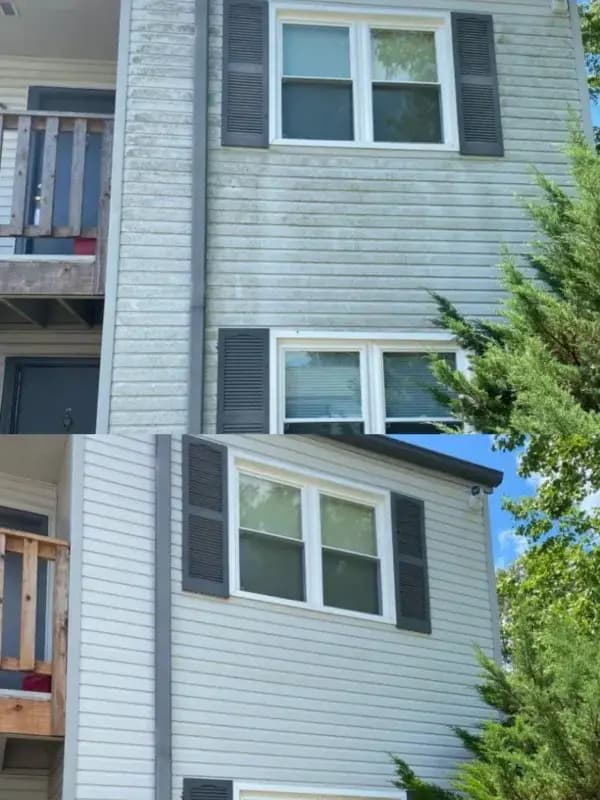
Because nothing is blasted, the granules stay where they belong. It is the method we use for roof washing, and the same gentle approach is how we soft wash siding as well.
What a careful roof wash should look like
- A walk around the house first, looking at the roof, the gutters and the plants below.
- Shrubs, flower beds and grass near the house soaked with plain water, with delicate plants covered.
- The solution applied at low pressure, a section at a time, so it never dries on the roof before rinsing.
- A thorough rinse of the roof, followed by another rinse of the plants, beds and walkways below.
- An eye on gutter and downspout runoff so it does not pool in a flower bed.
Plant damage from a roof wash is a process failure, not an unavoidable cost. Soaking, covering and rinsing are what prevent it, and they should be part of the job, not an extra.
Can you clean black streaks off a roof yourself?
Not with a pressure washer, which is what most people reach for and what does the damage. Low-pressure chemical cleaning is the correct method, but roof work carries its own risks.
A roof wet with cleaning solution is slippery, and ARMA's own bulletin warns about exactly that. Add a ladder, a hose, a sloped surface and a hot afternoon, and the danger is real. Solution that drifts onto shrubs or runs into a bed can also burn plants that were not soaked and rinsed.
There is plenty a homeowner can do without walking on the roof: keep gutters clear, watch for granules collecting at the downspouts, and have overhanging branches trimmed back. The roof surface itself is better left to a crew with the right equipment.
How long does a roof cleaning last?
Nobody can give you a fixed interval, and anyone who does is guessing. ARMA itself notes that cleaning is only temporary and the discoloration may come back. How fast depends on shade, tree cover and which way the roof faces, and it varies house to house on the same street.
A heavily shaded north slope under mature trees will show growth again sooner than an open roof. We will tell you what to expect for your specific roof rather than quoting a blanket number. If the honest answer is that you will want this done again in eighteen months, we would rather you knew that before booking.
Ways to slow the regrowth
- Trim branches back so more sunlight reaches the roof, which ARMA recommends.
- Have leaves and debris cleared from valleys, where two roof slopes meet, and from behind chimneys.
- Keep gutters clear so the lower edge of the roof drains and dries.
- When the roof is due for replacement, ask about algae-resistant shingles made with copper granules that are designed to slow growth.
- Zinc or copper strips are another option during a roof replacement. ARMA does not recommend adding them to an existing roof because of the risk of leaks or wind damage.
When a streaked roof needs more than a wash
Sometimes the streaks are the least of it. If a roof is shedding granules, with bare patches on the shingles or grit like coarse sand collecting in the gutters, or if shingles are curling or cracking, a cleaning will make it look better without making it any younger.
Because we wash roofs and replace them, we can give you a straight answer about which one yours needs. If a wash or a repair is what the roof needs, that is what we will quote. If it is near the end of its life, we will tell you before you spend money cleaning it.
If the north side of your roof has gone dark, we are glad to take a look. The ACM Pros is a family-owned, licensed and insured exterior contractor based in Madison, and our in-home estimates are free, in writing and come with no pressure to sign. Request your free estimate or call (256) 585-6817, Monday to Saturday, 7 AM to 7 PM.
Questions people ask
Is Gloeocapsa magma damaging my roof?
Not quickly, and it will not cause a leak on its own. It keeps the shingle surface damp and draws minerals from the limestone filler, and it often brings moss and lichen with it, which can lift granules and shingle edges. It is not urgent, but on an older roof it is not nothing either.
Can I clean the black streaks off my roof myself?
Not with a pressure washer, which is what most people reach for and what does the damage. Low-pressure chemical cleaning is the right method, but a wet roof is slippery and the solution can burn plants that are not protected. For most homeowners, the safest part of the job is the part done from the ground.
Why do the streaks only show on one side of my roof?
The north side gets the least direct sun, so it stays damp longest after rain and dew. Trees that shade one slope have the same effect. The organism needs that lingering moisture, so the slope that dries slowest is where it shows first.
How often does a roof need soft washing in North Alabama?
There is no fixed schedule. An open roof with good sun can go a long time, while a north slope under mature oaks may show growth again much sooner. We look at your roof's shade and orientation and tell you what to expect before you book.
Will a roof wash hurt my plants or grass?
It should not. Soaking plants with plain water before cleaning, covering delicate ones and rinsing everything afterward is what protects them. When plants are damaged, it is because one of those steps was skipped.
Do the black streaks mean I need a new roof?
Usually not. Streaks on their own mean the roof needs cleaning, not replacing. If the shingles are also curling, cracking or losing a lot of granules, that is a separate question, and we will tell you honestly which one you are looking at.